Tuesday, January 8, 2013

New destination for adventure tourists

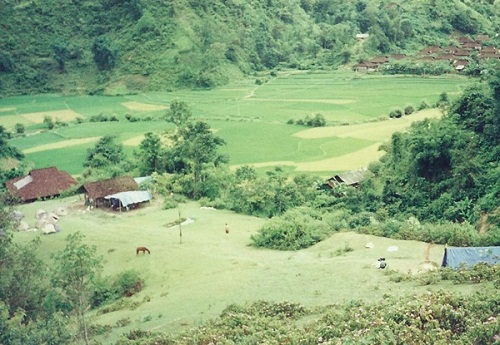
Dong Van-based Karst Plateau Travel brings amazing trekking routes between the rocky town, Mong people villages in Ma Le and Thien Huong as well as up to the Ma Pi Leng pass.

Trekking routes via the Karst plateau of Dong Van Town, located in northeast Ha Giang Province, have become increasingly popular since it was recognized as part of the Global Network of National Geoparks (GGN) in 2010.
The 18km route from Ma Le to Thien Huong has become famous for the valley of rocks due to its spectacular natural appearance. As per schedule, tourists with Vietnam guider are taken to Ma Le Village, 5km from central Dong Van, via van before embarking on a full-day tour.
“The trip is amazing. The landscape and natural conditions across the 1,600m above sea level area has lured many travelers,” said Karst Plateau travel agent Hoang Anh Tuan. “The wild routes offer the perfect conditions for memorable experiences like barbecues,” he said. Tuan added that tour groups are always accompanied by local Mong guides to avoid people getting lost.
Tourists who travel to Vietnam are additionally provided with sticks and jungle-knives to help them make their way through dense undergrowth. Ta Lang Village, home to the hospitable Giay and Tay ethnic groups, is the first stop.
“Because tourists often can’t speak their language, the hosts may refuse to welcome them into their homes. That’s where we as guides come in handy,” said local guide Li Thanh Hong.
“We always prepare lunch near the Nho Que river-bank while often buying either goat or chicken meat for barbeque parties in the jungle,” Hong added.
“It’s like a wild life lunch. Local guides often teach tourists how to catch fish by hand,” said tour guide Luc Thi Thuy. She added that fish is mostly grilled alongside moss while chicken is coated with clay before being placed on the fire.
Vertical limit: The route is very tough and challenging, and the mountain pathways are almost vertical in places. Ban Mo Village is another favourite stop over for lunch with visitors seated on stone slabs in the middle of the Nho Que River in the dry season. The last and final trek of the day, running 7km uphill from the river-bank to the top of the Ma Pi Leng mountain pass, takes a challenging two hours.
“The route is very tough, but also very interesting. The mountain pathways are almost vertical,” said Anh Tuan, who designed the route two years ago.
“When you reach the top, the river looks like a silk thread cutting through the deep valley.” The tour reaches its end on top of the Ma Pi Leng mountain pass from where tourists are taken back to Dong Van Town to while away the afternoon in exploration. Tour operators offer packages from US$100 for groups of four, which includes transportation from Ha Noi to Dong Van Town.
Karst Plateau also supplies trekking tours through Tam Son Town in Quan Ba District also as within the districts of Yen Minh and Meo Vac. Tourists regularly benefit from exploring the UNESCO recognised town as a member of the Global Network of National Geoparks. The town’s main market day falls on Sundays while it lights up with lanterns on Saturday nights. Dong Van Town is a definite must on the tourist radar because of its spectacular natural surroundings and its well preserved cultural and ethnic heritage.

Sunday, December 23, 2012

Kim Hy nature resere in Bac Kam province

Kim Hy Nature Reserve is located in Vu Muon, Cao Son communes in Bach Thong District and Luong Thuong, An Tinh, Con Minh communes in Na Ri District, Bac Kan Province.
Covering an area of over 14,000ha, the nature reserve has hundreds of rare flora and fauna species which must been managed and protected closely, Vietnam travel news.
Kim Hy Nature Reserve-Bac Kan province
Kim Hy Nature Reserve - Bac Kan Province
It is assessed as the reserve of primeval nature by Vietnamese and foreign scientists with hundreds of rare flora and fauna species. Among them Presbytis francoisi francoisi, squirrel, monkey are endangered species all over the world. Specially, in Vietnam tourism, visiting Kim Hy Nature Reserve, you will see diversity of bat species reputed most species in Vietnam. In addition, the natural reserve is large valuable wood-store of Bac Kan Province with hundreds of thousands of nghien, lat, dinh trees, mountain pine, etc.


Kim Hy is also home to endangered flora species such as stone-pine (thiet san gia) which is only present at 4 mountainous provinces of North Vietnam and two provinces of Guangdong, Guangxi (China). Besides diversified fauna and flora, the Kim Hy Natural Reserve is abundant in minerals, especially gold.

From Dusk To Dawn at crocodile lake

Nestled deep in the middle of the more than 70,000-hectare Cat Tien national park is a large freshwater lake that local forest rangers call Bau Sau (Crocodile Lake).
The aptly-named lake is home to over 100 crocodile species but to see them requires patience and effort. The local ranger informed us that the best time to observe the long-tailed, hard-skinned and big-jawed reptiles are either when dusk is falling or dawn is breaking.
Dawn and dusk are the quiet periods at the lake for the crocodiles to emerge from the tranquil waters and rest on the banks which are bordered with grass bushes. However, most trips to see the crocs are at night when a ranger with a battery-fueled light accompanies his guests on a trip along the banks of the lake to protect them and to show tourists where crocodiles sit onshore at night.
When the ranger sees two red spots in the distance, he will tell his guests to be silent as he moves in slowly toward the spots that he knows are the eyes of a crocodile.
If luck is on their side, the ranger and tourists can get real close to the crocodile and they may also catch the sight of a herd of deer looking for food on the outskirts of the forest as a reward for their trekking for hours in grass bushes and in the dark wild.
The search for crocodiles often ends some hours before midnight, as guests are advised to go to bed early so that they can wake up in the wee small hours in preparation for a boat ride on the lake before the sun rises in the east. It can be a hair-raising trip and not for the faint-hearted.
Crocodiles are not usually afloat on the water to wait and greet curious and nervous people on the boat, but sometimes they hit the boat when they move underwater in the lake. A common scene is of currents
Tourist shoots pictures of Crocodile Lake at dusk
of water created by the crocodile when the reptile swims away when the boat approaches.
It’s a nice surprise that many birds of different colors are seen perching in the trees and wandering in grass bushes on islets in the lake in search of food. In the early morning and at sunset, these birds sing in chorus and help visitors forget their fears about what is lurking a few feet away under water.
The water of the lake is so transparent that it reflects beautifully-shaped old trees and birds flying in the sky, making the lake and surroundings like a picturesque painting. Of course, this painting looks different when the crocs are ready to pounce.
Cat Tien National Park is around 150 kilometres from Ho Chi Minh City. A 10 kilometre car drive from the park’s management office will lead to a path, on which adventurers have to trek five kilometres through vast areas of trees to reach Crocodile Lake. It’s worth the effort.

Thursday, December 20, 2012

Dalat City- A Rhythmic Land of Flowers and Romance

For any couples who are falling in love, staying at Dalat city will be a perfect choice. Considered as a rhythmic land of flowers and romance, Dalat will refresh your love and turn it into a happy ending for sure.


“Listening to the noon going down in the romantic town, a Da Lat-violet is filled with fog…” (Written by Minh Ky, Da Cam)  is lyric of a famous song about Da Lat – one of the top prioritized destinations in Vietnam for its romantic and flowerful beauty. Located in the South Central Highlands of Vietnam (Lang Biang Highlands), Da Lat was originally the playground of the French, and today’s “valley of love”, surrounded by cool, fresh and silently charming atmosphere.
Weather
Da Lat is extremely famous for mild weather. Thanks to the advantage of height and enclosing pine jungle, the town is featured with temperate climate, with an average temperature of 18oC – 21°C, highest as 30oC and lowest as 5°C.
What is more, Da Lat has two distinct seasons, the rainy and the sunny ones. The former is from May to October, and the former from November to April. Tourists in Vietnam travel should be prepared for sudden rains in sunny season, sometimes rocky ones.  Never in Da Lat could we ever catch a storm, which make it favorable for tourists to take any daytime leisure walk.
History
This pure land of romance was discovered by the French during their invasion in southern Vietnam. Before 1893, Lang Biang highlands, an extremely cool and fresh aired area, was the accommodation of the Viet highlanders. Yet there came the day the French would like to settle a convalescent zone in a European weather-like land in 1899. Of course, they could not miss Lang Biang Highlands then. Da Lat was later on built with all required French-style houses, villas, treatment places, and temperate flowers & plants, etc. This has step by step formulated today’s romantic and glamorous Da Lat, a clear mountainous air zone for escaping the heat and humidity of the coast and Saigon, or the today’s Hochiminh City.
Natural beauty
Dalat City- A Rhythmic Land of Flowers and RomanceIt’s no easy at all for travellers to choose the initial visiting place in Da Lat for its widespread covering beauty. On a whole, Da Lat looks like a cross between Vietnam and the French Alps. As mentioned, most of its hotels and houses were built in French style. The town spreads across a series of pine-covered hills, with a small lake in the center, while surrounded by high peaks, creating lovely scenery quite different from the rest of Vietnam. Temperatures are pleasantly warm by day and quite cool at night, down to perhaps 10oC.
Today, Dalat is undoubtedly a beautiful tourist town. The vast majority of visitors are both domestic and foreign tourists on short package tours, drawn by the scenery, vivid blue skies, fresh air, flower-filled parks, and local edible treatment. Dalat is a favorite destination for company weekend outings, family get-aways, and most of all, honeymoons. For overseas visitors, it offers a chance to cool down, view a bit of the French legacy, and enjoy the atmosphere. Also, Da Lat is surrounded by some of the best mountain biking, hiking and canyoning opportunities in Vietnam. Da Lat's high altitude of 1,500-2,000m and fertile landscape make it one among Vietnam's premium agricultural areas, producing a variety of fruits, vegetables and flowers that do not grow in the lowlands. In markets as far north as Hanoi, vegetables and flower vendors will tout their "made in Da Lat" produce.
Top visiting places
 Whoever has come to Da Lat could never forget Xuan Huong Lake (Hồ Xuân Hương), which is located in center of town. Xuan Huong Lake is now one of the main draws of Da Lat, and also where we can see honeymooners and locals to stroll its banks. Side by side Xuan Huong Lake is Top-peg Hill (Đồi Cù), where has grown up a vast golf ground. If you are fond of fresh flowers, Da lat Flower Park is your accurate choice. The park, around 7,000.00 square meters, is situated on top of the Top-peg Hill, northern bank of Xuan Huong Lake, and full of species of beautiful colored flowers to be extremely well-fed by planters. Tourists are all interested in the Da Lat’s flower festival, bringing them to a flowerfully fresh heaven!
Dalat City- A Rhythmic Land of Flowers and Romance
For couples, Valley of Love (Thung Lũng Tình Yêu) is the premium place to go. Its special name derived from its romantic view of silence, grace and green. The other choice is Lake of Sorrow or Lake of Sighs (Hồ Than thở), whose name came from a tale of two lovers, one of whom committed suicide after the other was called up to serve in the army. The romantic and beautiful Tuyen Lam Lake (Hồ Tuyền Lâm) (the lake where rivers, springs and forests meet), Prenn Falls, or Pongour are also worth visiting for their beauty and fun.
On the other hand, Da Lat is popular for French-style architecture. Examples are King Bao Dai’s Palace, Ngo Dinh Diem and Nguyen Cao Ky’s villas, Hang Nga villas, and so forth. All of those should really be visited since they demonstrate the deeply special beauty and somehow culture of the old French. 
Tourist activities
  • A striking, not-quite-finished fantasy house designed by the daughter of an independence war hero. Worth a visit if you are interested in architecture, or like Dr. Seuss-style surroundings.
  • A set of flower gardens centered on a re-constructed traditional Vietnamese teakwood house.
  • A hill-top pagoda coupled with a brief cable car ride over the pine forest
  • A ride in a land rover up to the top of Langbiang Mountain, with nice views of Dalat and the surrounding mountains and valleys.
 Paying a visit to Central Highlands and you are in Lam Dong in Vietnam travel, Dalat city will be a must-visit place that you should not ignore.

Monday, December 10, 2012

Tran Bien Literature Temple- a peaceful and silent space


Tran Bien Temple of Literature, built in 1715 under King Nguyen Phuc Chu, was the first temple of its kind in the South. It is a place to honor Confucius and also serves as an educational center. Tourists in Vietnam travel will learn a great deal about the history of Vietnam through the stories of the national heroes and icons.
Architecturally inspired by the Quoc Tu Giam (Temple of Literature in Hanoi capital), the Tran Bien Temple of Literature was rebuilt twice in the Nguyen Dynasty and then destroyed by the French in 1861. Then It was restored in 1998 and the first phase was inaugurated during the Tet holidays in 2002. The last phase is under construction.
Nestled near Buu Long Cultural Park, about 3 kilometers from the center of Bien Hoa City, the temple is emerging as a peaceful and silent space, with curved domes and majestic rooms under the shade of green trees standing in harmony with the surroundings.
The first sight in the temple is Van Mieu Mon (Mon temple of literary), a traditional stele house carved with the glorious epic of Vu Khieu about the process of building the country, building the temple, typical national revolutions as well as educational and cultural traditions of Bien Hoa City.
Visitors in Vietnam tourism can also discover more about Vietnamese history in the tranquil setting of Tinh Quang Lake, as well as at Khue Van Cac, Dai Thanh Mon and especially the stele house of Confucius.
The most striking aspect of the temple is the Bai Duong sanctum, built in old style architecture with red-lacquered designs with parallel sentences hung on pillars. In the center is the altar of the Vietnamese late president Ho Chi Minh in front of a picture of a traditional bronze drum behind.
18 kilograms of soil and 18 kilograms of water from Hung Temple symbolizing the 18 Hung kings and the origin of Vietnam were displayed in the temple. The temple also honors some cultural icons such as Chu Van An, Nguyen Binh Khiem, Nguyen Dinh Chieu, Le Quy Don, and Le Quang Dinh.

Duong Long Cham Tower, a beautiful architecture


Duong Long Tower was built in the 12nd century with very beautiful architecture. It is also called Thap Nga meaning "ivory tower". 
The Tower is located at Go Dang, Binh Hoa Commune, Tay Son District, Binh Dinh Province.

This towner comprises of three biggest towers. It was built in the 12nd century with very beautiful architecture. Duong Long Cham Tower, also called Thap Nga meaning "ivory tower" is located  about 40km from Quy Nhon and 270km from Danang City. The highest tower, 35m high, is in the middle, and the two others are 22m.
Built of bricks, its corners have got motifs with stone carvings of sacred animals such as Garuda birds, elephants, and eagles. Its gate faces the east and is rather high (about 1.5m) and the gates frame is made of big stones. Its upper part is built of big stones, which are skilfully superimposed on each other. Many big, body leaf-shaped bas embossments describing monks, dancers and singers are found on the walls.
These figures with rather big heads wear corner hats. Particularly, the top of the tower looks like a great lotus with its rising petals. All the decorative motifs of the tower are very big and carved on sandstone. This tower complex is one of the most beautiful in Central Vietnam

My Son Temple


My Son is perhaps the longest inhabited archaeological site in Indochina, but a large majority of its architecture was destroyed by US carpet bombing during a single week of the Vietnam War.
Located near the village of Duy Phu, Duy Xuyen district, Quang Nam province in Central Vietnam, 69 km southwest of Da Nang. The My Son temples are in a valley roughly 2km wide that is surrounded by two mountain ranges.
From the 4th to the 14th century AD, My Son valley was a site of religious ceremony for kings of the ruling dynasties of Champa, as well as a burial place for Cham royalty and national heroes. Closely associated with the nearby Cham cities of Indrapura (Đồng Dương) and Simhapura (Trà Kiệu). At one time, the site consists of over 70 temples as well as numerous stele bearing historically important inscriptions in Sanskrit and Cham.
The My Son temple complex regarded one of the foremost Hindu temple complexes in Southeast Asia, is the foremost heritage site of this nature in Viet Nam. It is compared with other historical temple complexes in Southeast Asia such as: Borobudur of Java inIndonesia, Angkor  Wat of Cambodia, Bagan of Myanmar and Ayutthaya of Thailand. In 1999, My Son has been recognized by UNESCOas a world heritage site.


Most of the temples at My Son were made of red brick, and only one (the temple labelled "B1") was made of stone. Even the decorative carvings on the Cham temples were cut directly onto the bricks themselves, rather than onto sandstone slabs inserted into brick walls as is observable for example in the 9th century Cambodian temple of Bakong.
Today, the construction techniques used by the Cham builders are not completely understood. One thing that have not been completely resolved include issues about the firing of the bricks, the mortar between the bricks, and decorative carvings found on the bricks.